When George W. Bush was in the White House, I remember being taken a bit aback by how little he seemed to care about and/or enjoy any aspect of the enterprise: running, winning, being president. Having never before seen someone who so clearly didn’t want to be president be president, I was haunted by one question: Why did he not pluck one of the 12 gazillion non-presidential options available to even dim-witted scions such as he? Then I read someone who I thought got it right. They said W was raised with a preppy’s approach to life, meaning that if there is a game out there you can win, it makes no sense not to play. So having missed out on what he often called his “dream job”—commissioner of baseball—he ran for governor, then president (both of which he could win thanks to an accident of birth), and unsurprisingly none of that turned out well for anyone, except maybe Halliburton.
This sprang to mind after a short text exchange with a friend with whom I have played tennis—and only tennis—for 40 years. We’ve watched tennis together, had lunch a couple hundred times, but played exactly zero other sports or games together in each of those four decades. So when he texted “Can you play Thursday?” I responded, “You mean tennis?” Admittedly, not a great joke, but I’ll argue a solid B, primarily for its opportunism, one of my favorite qualities in jokes with really short punchlines. But my point, and aren’t we all tickled I’ve got one, is that like W, my action was dictated by my upbringing: I raised myself with a smart ass’s approach to life, meaning that if there is a good joke to be made, it makes no sense not to make it. It’s not only funnier than W’s mandate, it got exactly zero Iraqis killed.
I have no memory of when it became important for me to be funny and to have funny people around a lot. I remember clowning it up in elementary school to impress my friends and avoid being bored, followed by painful, halting attempts to get girls to notice me in middle school. Since I was even more awkward, odd-looking, and had worse hair than most of my peers—not an easy lift—my wit was all I had. Things got better in high school, where being funny was currency that got me to the core of groups I would otherwise have clung desperately to the fringe of, like the smart kids and the jocks. Funny is almost always welcome, especially among kids, who are constantly testing the limits of everything—also one of humor’s prime directives.
If there’s a funnier or more fun way to say something, even though those paths are almost always longer, I almost always take them. Just now I concluded an unsuccessful search for a wire brush, and so when my wife comes home, because sometimes she knows where shit is, I’ll ask her. But I have decided that instead of doing so in an economical, customary, and likely to her preferable manner, I’ve decided to say “So let’s say just for the sake of argument that this morning you woke up in a state not unlike Gregor Samsa, who as you undoubtedly know is the protagonist in The Metamorphosis, Franz Kafka’s classic exploration of alienation, absurdity, and the burden of family, only instead of a cockroach you were a wire brush. Where would you be?” Now because she often has important things to do immediately upon arriving home she would prefer that I just ask in a normal way and often I will, especially if she seems to be busy. But sometimes I won’t, and sometimes I rationalize holding her up for a few seconds by including in my often-not-worth-the-journey-given-the-punchline jokes one that comes at my own expense, as those are her favorites. In this case it’s funny because while I did read The Metamorphosis in college, I am not a well-read person when it comes to books. (And lest you think any of this is easy, know that I obsessed for a full minute over which is funnier, “I am not a well-read person when it comes to books,” “I am not well-read when it comes to books,” or “Johnny no read books no more.”)
One of life’s best low-investment/high-reward activities is injecting humor into the most mundane interactions with the most unlikely audiences. Even a self-taught mirth-maker like me knows surprise is one of humor’s foundational elements, and so it follows that surprising statements in surprising situations are double funny. I also know that I have pre-disastered this joke with this preamble, but I’m willing to take that hit in the interest of science, to wit: I like to spell my last name before I say it when speaking by phone to anyone in customer service, as that way they’re kind of forced to mispronounce it and, because serving me is in their freaking job title, they feel compelled to apologize and that’s when I amuse, disarm, and delight them with the following line: “That’s okay, I mispronounce it too sometimes.” Yes it’s stupid, but I promise you it gets a laugh 100% of the time because 1) it’s the last thing they expect me to say, 2) it breaks the tension they feel over having to deal with my impossible to pronounce last name, and 3) it’s a little bit funny.
I have a few other go-to face brighteners for human interactions of both standard and unexpected varieties, but they often only come to me when the opportunity arises. Mistakes have been made in the slight misjudging of my audience, but I’m older and wiser now, meaning I know which lines should not be crossed with which individuals and groups. I sometimes budge myself across them anyway, because that’s in the job description even for amateur comedians.
To me, and I realize this is not true of too many people, if something is funny, it’s almost impossible for me to find it offensive. This is in large part because at the core of virtually everything I find funny is intelligence, and people whose primary purpose is offense are invariably too lazy and/or stupid to be funny even when they try really really hard. Take both Trump administrations in their entirety, for example. So yes, I may laugh at things others find offensive, and I may well be in the wrong, but this is my neighborhood and these are my people, and none of us is right all the time.
I have a million thoughts on the importance of comedy in virtually every important aspect of our lives, but those are for another essay. This is more about how it has been a key prism through which I have viewed the world for as long as my vision has been fixed. It’s in how much I love laughter, and how I recognize people by their laugh almost as much as their voice.
I love it when laughter bursts out of people in a way that even surprises them. I know people whose laugh I love so much I sometimes get carried away. I’m trying to get better but I’m old, there’s a limit, and I have yet to be taken to court. I know people who think I’m funnier than I do; not many, but still. These people should live in spas and have all their desires attended to by anyone who was mean to them ever but especially middle school.
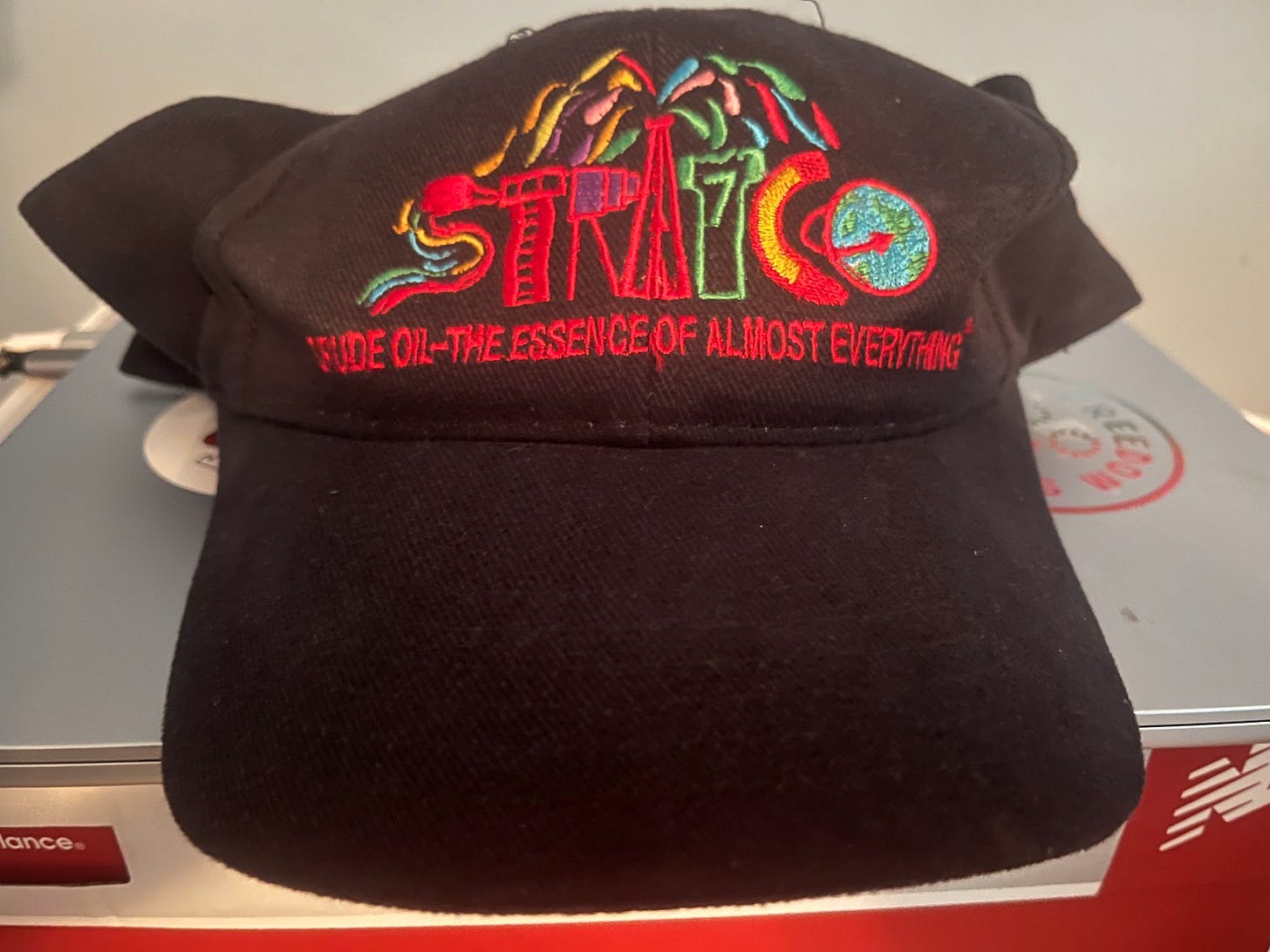
Unlike my wife, my kids and most of my friends, I did not choose a career path based on providing a palpable societal benefit. I plied my scribbles mostly for benign-to-beneficial entities and enterprises, with one notable exception: a book for kids on the wondrous history of crude oil for Stratco, leading maker of substances and processes that turn said crude oil into gasoline. Thankfully it never got published, and not only was I amply compensated but I also got this, which I know you’re now jealous of but it’s okay not to admit it.
And while my mission is significantly less targeted and entirely less professional than the aforementioned loved and liked ones, and I do agree with Teddy Roosevelt that “comparison is the thief of joy,” I take my silliness seriously, especially with kids, though if they’re properly cared for their default position is 75% of the way to laughter and they’re small so it isn’t hard to shove them the rest of the way.
But to be painfully obvious, everyone is happier when they’re smiling or laughing. It’s one of life’s best tells. And making it happen as often as one can, especially when the world sucks for so many, as it so often does, is an objectively worthy pursuit, which is good, because it’s mine. I don’t believe in much, but I do have faith in funny.