

The danger of me writing even one article about any NASA related topic is that you’d have to physically constrain me from doing so again just a week later. I basically opened Pandora’s box last week, so we need to collectively deal with it. I’ve been rereading Apollo’s Legacy: Perspectives on the Moon Landings, a 2019 book by Roger Launius, former chief historian at NASA, and I came across an information that I completely forgot about. Granted, the last time I read the book was in the spring of 2022 when I was in the trenches of my final exams, doing my internship and writing my BA thesis. But when I was reminded that NASA already faced a serious controversy even before the 2007 Lisa Nowak scandal, which deserves a stand-alone article, I knew I had to dive deep.

The ninth crewed mission and the fourth Moon landing of the Apollo program was set to be just a regular mission, focused on retrieving samples of the Genesis Rock, thought to be part of the Moon’s early crust, and to prove Galileo’s theory that objects of different masses fall at the same rate when there’s no air resistance by using a feather and a hammer to demonstrate it. The twelve days that commander David Scott, command module pilot Alfred Worden and lunar module pilot James Irwinspent in space transformed into the agency’s biggest scandal just a year later when the world learned the three astronauts were carrying NASA contraband.
From the very beginning of the Space Race, astrophilately, the collection of stamps and postmarked envelopes related to spaceflight, started gaining prominence. Both the USSR and the U.S. issued commemorative postage stamps following certain missions and milestones. In the case of NASA, only the U.S. Post Office Department, nowadays the United States Postal Service, was authorised to issue the creation and distribution of said stamps. So, when it became public knowledge that the Apollo 15 astronauts carried privately produced postal covers and stamps, serious issues arose.[1]

Sometime in 1970, Scott, Worden and Irwin were contacted by Horst Eiermann, the man who would produce around 400 unauthorised postal covers. Eiermann can be best described as a memorabilia dealer who closely worked with a West Germany stamp dealer, Hermann Sieger. The two made a deal with the crew of Apollo 15: if they took the covers and stamps with them to the Moon and sent them back to Sieger as memorabilia he could sell once they came back, each of the three astronauts would receive $7,000 ($54,000 in 2025).[2] And that’s exactly what they did.
Commander Scott smuggled the covers in the pocket of his space suit on launch day, July 26, 1971. The covers were postmarked before launch and again on USS Okinawafollowing the splashdown on August 7. Between July 30 and August 2, the covers had even spent time on the Moon aboard the lunar module Falcon. Command module pilot Worden carried 144 additional covers for his friend F. Herrick Herrick, a film director and philatelist.[3] Lunar module pilot Irwin carried ninety-six more covers with various designs, mostly honouring Apollo 12, brought as a favour for Barbara Gordon, wife of Apollo 12 astronaut Dick Gordon.[4]
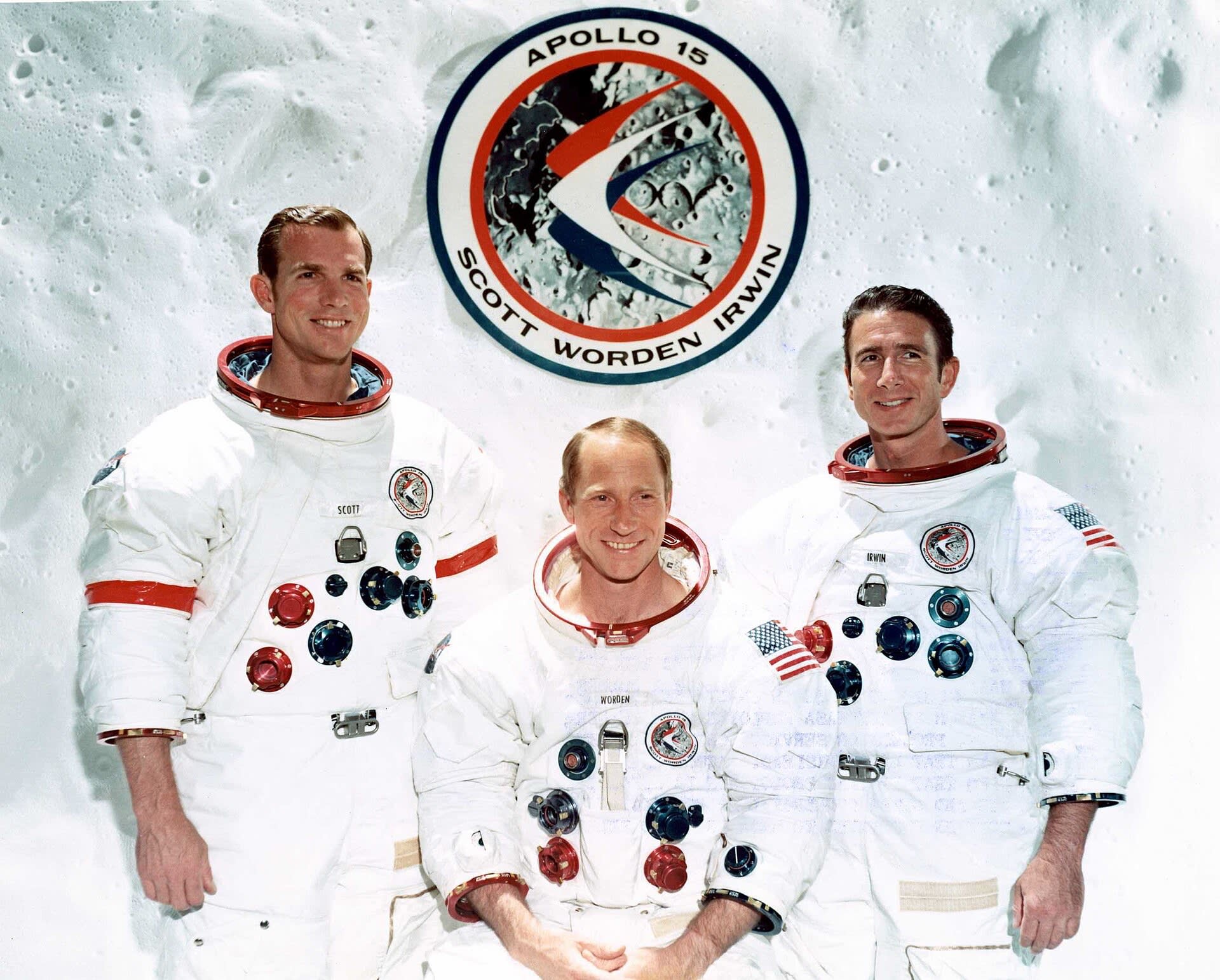
By early September 1971, Scott had sent one hundred covers by registered mail to Eiermann, whilst the remaining three hundred were used for private commercial distribution, mostly by the astronauts themselves or their friends and family.[5] By the time the Apollo 15 crew went on an official NASA trip to Europe in November 1971, NASA had already received word of the suspicious collectibles when a potential customer for one of Herrick’s covers contacted the agency to ask about the memorabilia’s authenticity.[6]
Commander Scott realised the three could face serious consequences when he learned that the distribution of covers began in Europe as well, telling Irwin, “Jim, we are in trouble now - they are starting to sell the envelopes over there.”[7] See, the primary problem was that the Chief of the astronaut office Deke Slayton issued regulations in August 1965 requiring astronauts to declare all items they intended to carry, have them approved by him, and ensure they were safety-checked for spaceflight if similar items had not been previously flown. The covers and stamps were not declared. In addition, NASA’s 1967 standards of conduct prohibited astronauts from using their professional position to generate profit for themselves or others outside NASA: a rule the three clearly violated.[8]

By March 1972, NASA and Slayton became aware that the Apollo 15 crew actually transported unauthorised covers aboard the vehicle. For Slayton, who spent months supporting the three and, according to author Andrew Chaikin “went out on a limb to defend his people”, the discovery resulted in insurmountable disappointment and anger toward the crew.[9] Although NASA planned on keeping the story under wraps until an official investigation was conducted, The Washington Sunday Star released the details of the scandal on June 18, 1972. It’s safe to say that all hell broke loose shortly thereafter.
Even though Scott claimed the three never intended to turn a profit from the, so called, “Sieger covers”, NASA was unwilling and unable to turn a blind eye to a big violation of their policies and standards of professionalism. Scott was dismissed from the Astronaut Corps on August 7, 1972, exactly a year following his return from the Moon. He’d later become a technical adviser on the Apollo-Soyuz Test Project and would lead NASA’s Dryden Flight Research Center until his retirement in 1977.[10] Worden went to work for NASA’s Ames Research Center in California until 1975, whilst Irwin retired in 1972 and formed an evangelical group.[11][12]

As Launius states, what the Apollo 15 crew did wasn’t a “supervillain-level crime”. However, it was an example of disrespecting the agency’s policies and hoping hundreds of privately-made postal covers and stamps would go unnoticed among space fans interested in collectibles. Ultimately, the decision to remove the three from the Astronaut Corps was also a warning to others who might’ve had similar ideas or aspirations. You can try fooling NASA, but you’ll end up the fool.
Maybe it’s irrational to be envious of an inanimate object, or a whole bunch of them, but never have I wanted to be a postal cover more than I do today. Not only because they got to go to the Moon, but also because they’re so blissfully incapable of awareness, and that’s how I aspire to be. I should look into how I could sneak aboard Artemis IV. Now that would be one hell of a scandal.