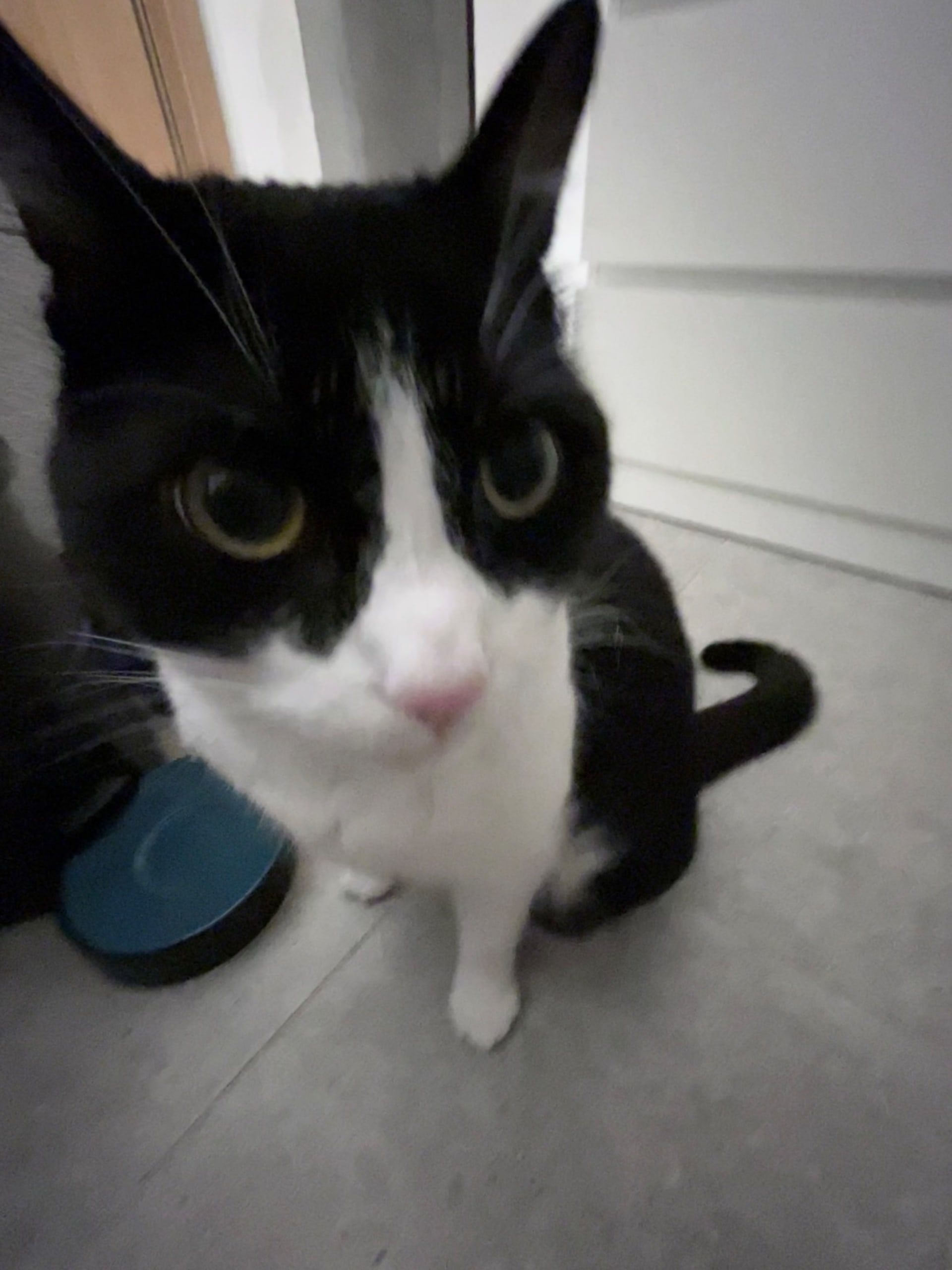

One of my best friends has a cat whose name is Roomy. Every time we hang out, have our tea and talk, Roomy tends to sit somewhere near and observe the two of us just catching up. I swear to god, the way he blinks and stares at me sometimes makes me believe he can understand everything we’re saying, and it’s safe to say it occasionally creeps me out. Ever since I learned that the CIA tried to transform cats into spying devices, I’m convinced Roomy is a secret agent sent by the FBI to monitor our highly suspicious conversations about work, recipes we have to try out and the inevitable moral decay of modern society. Although it’s been almost six decades since the project was canceled, Roomy leads me to believe the government is hiding something from us.
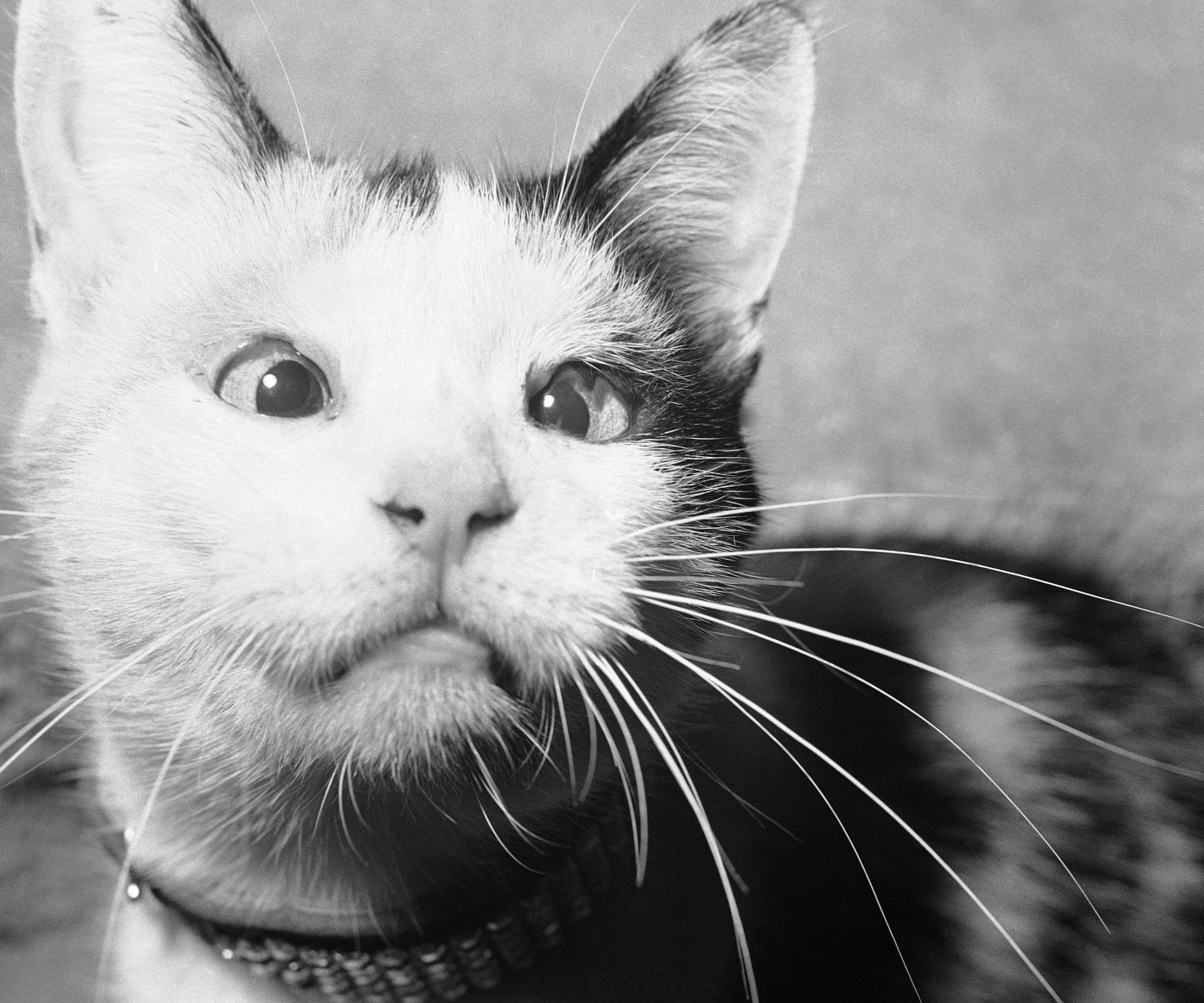
The 1960s were a bizarre time in U.S. history. Thanks to the fact that the Cold Warwas at its absolute peak, the U.S. government saw a potential Soviet threat everywhere. Although McCarthyism peaked a decade earlier, anti-Soviet sentiments were still largely felt. Paranoia was at its absolute zenith, and following the Cuban Missile Crisis in 1962, the CIA was desperate for any edge against the Soviets. This is where cats come into play.
The Directorate of Science & Technology, a branch of the CIA charged with designing and developing systems that enhance the agency’s intelligence capabilities, was the one to pitch the idea to the CIA. To be fully fair, this wasn’t even the weirdest case of non-human spies in the agency’s history. According to Bob Bailey, the first director of training for the Navy’s dolphin program, the program and the CIA “never found an animal they could not train.”[1] Ravens, pigeons, coyotes and even spiders were trained, but none became actual spies. The CIA was, however, hopeful that cats would prove different.
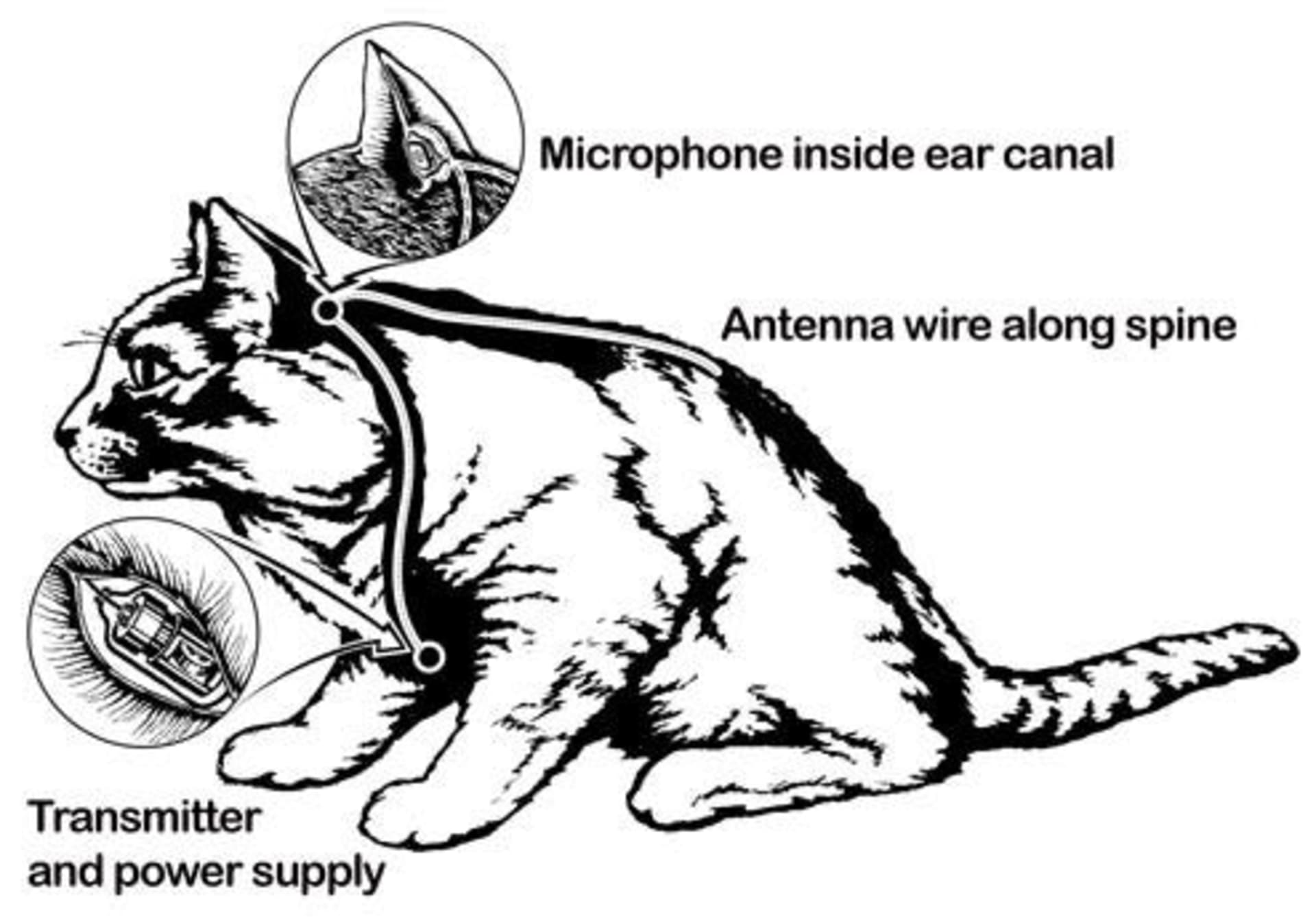
Although notoriously stubborn and disobedient, according to former CIA officer Victor Marchetti, cats were chosen because their cochlear anatomy allows them to filter and focus sound, much like humans. Marchetti explains, “the cat that was used for the experiments had to be cut open and have a power pack placed inside its abdomen. Wires were then run up to its ears and to its cochlea. The tail was used as an antenna and wires were hooked to its brain to determine when it was hungry or sexually aroused, with wires to override these urges so the cat wouldn’t walk off the job.”[2]
Nowadays, it’s unimaginable that a cat could be cut open to be turned into a feline radio transmitter, but we have to remember that there was no PETA in the 1960s. And if we keep in mind that the CIA used drugs and other mind-control techniques to influence behaviour and extract information from unwilling subjects between the 1950s and 1970s during project MKUltra, “Acoustic Kitty”, as the program is now known, no longer seems so far-fetched.[3]
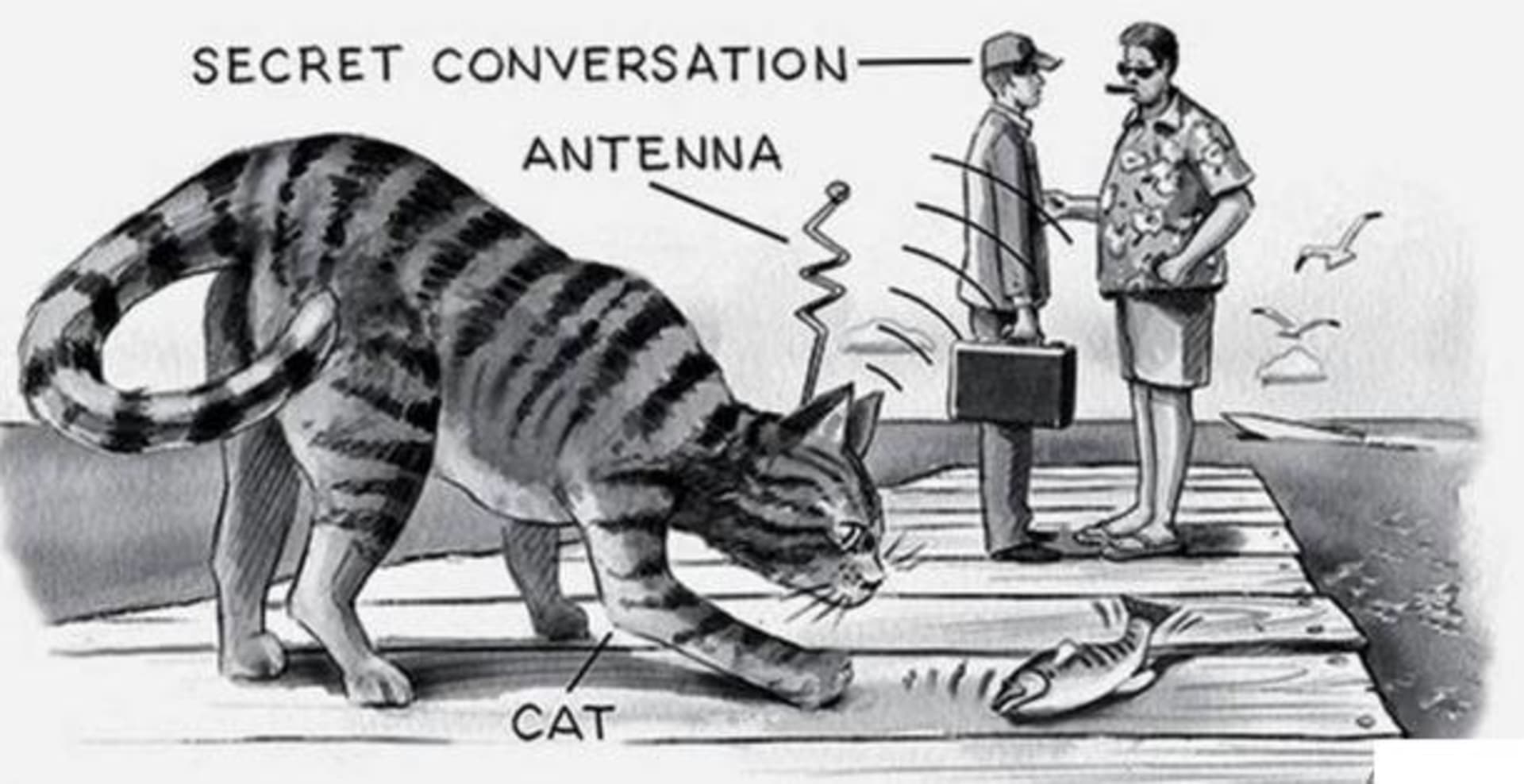
Unfortunately for the CIA, but fortunately for generations of American cats, the first and last mission of the project failed miserably. After training a cat to listen to human conversation, the soon-to-be secret agent went off on its first assignment. The target? Two men outside the Soviet embassy in Washington D.C. And so, off it went. The two agents that released the cat stood by excitedly, waiting to witness the marvel of American engineering and animal mutilation. However, the poor unnamed cat was hit by a taxi almost immediately and died shortly thereafter.[4]
Robert Wallace, former director of the Office of Technical Service, a component of the CIA, responsible for helping CIA covert operations by providing gadgets, disguises, forgeries, secret writing techniques and weapons, disputed the story of the unsuccessful first mission of “Acoustic Kitty”. According to him, the program wasn’t abandoned due to the failure of the first mission which never happened, but because cats proved much more difficult to train to behave as required for the job.[5]
Marchetti described CIA’s first unsuccessful feline spy as “this poor little monstrosity” which is both hilarious and sad. As someone who absolutely adores animals, it bothers me that they were perfectly fine with turning a cat into Frankenstein’s monster for nothing. Marchetti also disclosed that the whole project cost around twenty-five million dollars, all of which went down the drain upon the failure of its first mission.[6]
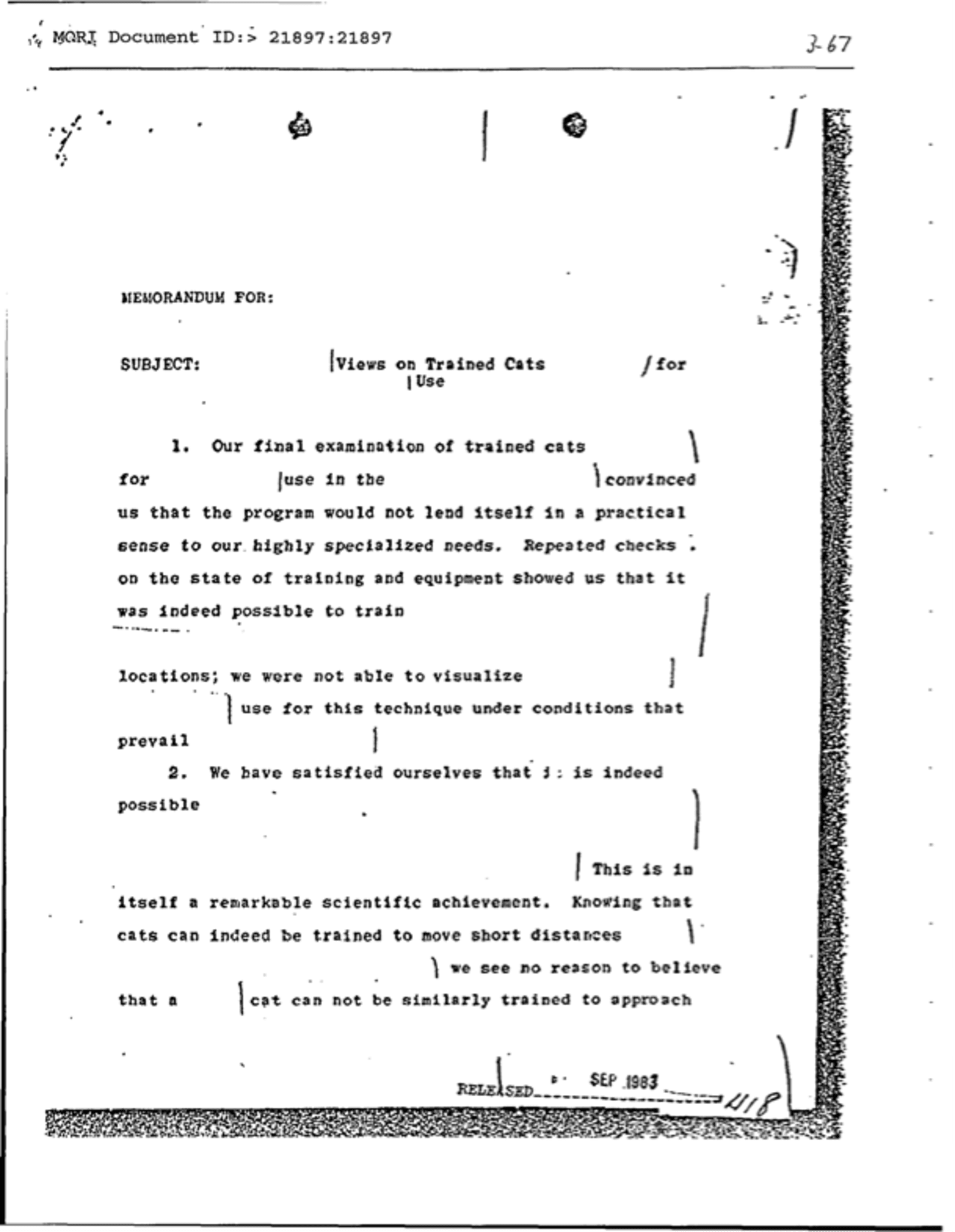
Although it came to an end in 1967, the project was classified until 2001 when only limited information was released to the public. According to Henry Schlesinger, Robert Wallace and Keith Melton, authors of the 2008 book Spycraft: The Secret History of the CIA’s Spytechs from Communism to Al Qaeda, the 1983 memo released in 2001 that disclosed the project’s goals and methods is severely redacted because the “CIA was embarrassed to disclose all the details of the project.”[7] Instead, the government only indicates the project “would not lend itself in a practical sense to their highly specialised needs.”[8]
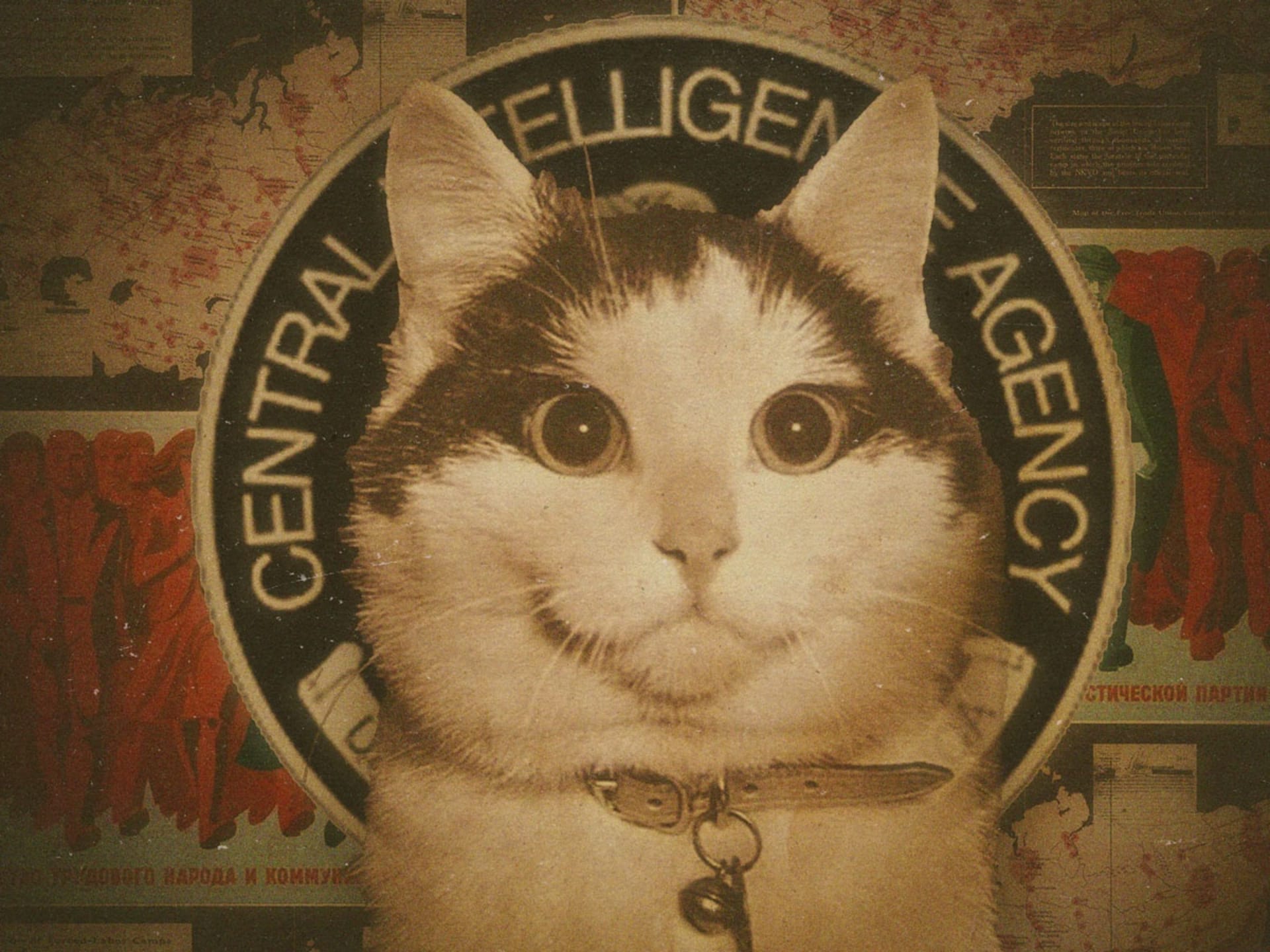
I’ve known about this project for a while now and it still never fails to amaze me it was actually real. I’m somewhere in between thinking “geez, the CIA was absolutely unhinged” and “yeah, the ‘60s were insane and they were just being creative.” Still, it’s hard to find a good enough reason to justify mutilating an animal to serve any purpose. So, yes, I most definitely condemn this madness, but there’s no denying that it makes for a good story.
With all that being said, I still harbour serious suspicion about Roomy. That cat knows something and that’s been keeping me up at night for months already. Okay, I might be exaggerating a bit, but the fact that “Acoustic Kitty” was an actual thing definitely doesn’t work in my favour. Oh well, if the FBI comes knocking on my door, you guys will be the first ones to know.